
Welcome to Hansa! We have a number of local offices around the world. If we have zoned you incorrectly, please select from the following options.
Chipping Away – Ian Toyn, published in TreeCropper Magazine
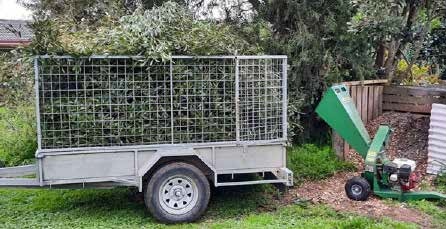
Chipping Away – Ian Toyn, published in TreeCropper Magazine
I bought a Hansa C7 chipper in 2014 after being impressed by a demonstration at the Hansa site at Fieldays, and I am still using it. Hansa is still selling this model with the same specification, though the design has had minor changes.
Ease of Operating
The design is based around a 12.5 kg flywheel with two knives, spun at up to 2,850 rpm by an engine. You feed branches into a steep inlet chute that narrows towards the flywheel. Gravity helps with feeding, as does airflow generated by the spinning knives, and the cutting action of the knives themselves. If all that doesn’t suffice to pull a branch through, then the next branch can be used to push it through. Divaricating side branches often need such a push, with the narrowing inlet chute helping by bending or breaking them. Chippings exit via a rising outlet chute to a deflector for directing the chippings in a desired direction.
Branch size
The specification says that the maximum capacity (i.e. branch diameter) is nominally 70 mm, yet the knives are 110 mm long and the inlet chute has a 130 mm opening. The two knives are offset so that the full 130 mm could be cut. In practice, the maximum diameter of branches that can be chipped is also limited by how
the user feeds. The chipping action slows the flywheel, so pauses are needed to allow the flywheel to regain its angular momentum. Arborists’ big chippers automate this - you may have heard the rhythmic bite-rest-bite-rest sound that they make. The C7 doesn’t automate this, so you should avoid feeding too much in at once. It chips effectively so long as you don’t make excessive demands. Don’t expect it to cope with more than 70 mm diameter - the larger opening is to ease feeding in kinked branches.
Mobility
The machine is mounted on two wheels to ease moving it around - its >90 kg weight would otherwise be hard to shift. It rolls easily on a level sealed surface, and I can push it over a couch grass lawn. It can be fitted with an optional towing accessory, with either a hitch pin for behind a ride-on mower or a coupling for a tow bar. However, the wheels aren’t roadworthy, so if a friend wants to borrow it, you may need to lift it up into a trailer. The wheels are smaller than that on a standard wheelbarrow, so not ideal for rolling over a rough paddock. If a tyre’s inner tube is punctured, the easiest fix is to fill it with slime.
Maintenance
Maintenance involves greasing (four) nipples, sharpening the knives, and tensioning drive belts. It’s best to chip promptly to avoid branches drying out and hardening, otherwise the risk of blunting the knives increases. Blunter knives cause more slowing of the flywheel, reducing chipping efficiency. Owners can sharpen knives themselves, but retailers are likely to have a more appropriate tool for that. The engine has always (till now) been a Honda GX200, which is a four-stroke petrol engine. The unfortunate need to use fossil fuel shouldn’t be the case for much longer: Ego already has a battery-powered engine that looks
sufficient, while Makita is progressing from a less powerful one.
Output
I usually chip into pallet bins, not only because of accessibility for the chipper but also to give chippings with green material time to heat up and cool down before being used. Alternatives include chipping directly to where the chippings are to be used; into a container such as a trailer; or onto a heap on the ground. Surprising tip: a lightweight hay fork can pick up chippings, especially if they’ve sat long enough for fungi to stick them together.
Dietary preferences
The value of a chipper is in what it consumes, what it produces, and how efficiently it does so. The C7 can consume not just branches but also vegetation, for example I give mine yacon stems and Strelitzia stalks. I avoid feeding through cabbage tree leaves or bamboo (though Hansa claims it could cope with those). Much of what the C7 can consume ends up producing what’s known as ramial wood chips, which I value highly. Ramial wood chips are small, and have a carbon to nitrogen ratio that allows them to rot down quickly while being food for fungi. Spread around trees, ramial wood chips lead to improved soil structure, and the fungi bring nutrients to the trees. The C7 is an ideal model for producing ramial wood chips: a larger model would produce bigger chippings and the thicker
branches would raise the carbon to nitrogen ratio, while a smaller model would be less efficient. For small gardens, a C7 would be overkill. For near neighbours, it’s a deafening monster.
If you have requirements for a chipper that match the C7’s capabilities, as mine do, then I’d highly recommend it.
As published in TreeCropper Magazine, Issue 126, June 2026